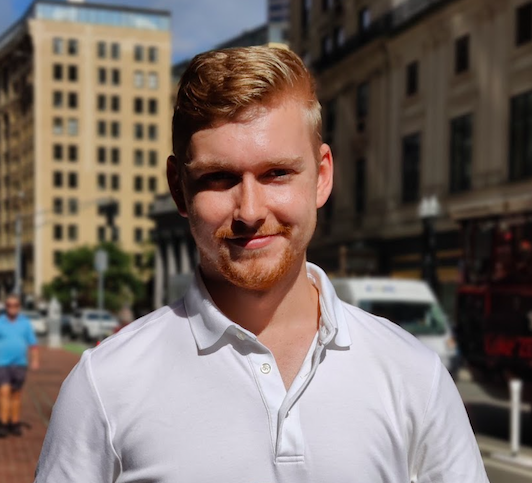
WESTFORD — Colin Bode, Westford’s new Veterans Services Officer, comes with years of experience working with veterans and serving in the armed forces himself. He now hopes to give back to fellow veterans and help them access the services they need and deserve.
Bode began his new role as Veterans Services Officer on May 23, 2025. He previously served in the Massachusetts Army National Guard for seven years, which included a deployment to the U.S. Embassy in Baghdad during Operation Inherent Resolve. He was awarded the Army Commendation Medal with C-Clasp for combat operations two times, and he managed federal equipment and coordinated defense operations with NATO forces. While in Iraq, he also served as a suicide prevention officer and worked to support the mental health and well being of his unit.
In addition to his service with the armed forces, Bode also has lots of prior experience working in veteran advocacy, crisis management and public service. He comes to Westford from the Clear Path for Veterans New England in Lawrence, Massachusetts, where he served as the Supportive Services for Veterans and Families Grant Program Coordinator. While at Clear Path, Bode was responsible for supervising staff, coordinating housing placement for homeless veterans across the state, and working to strengthen partnerships with public and private agencies. Also at Clear Path, Bode helped rehouse more than 40 veterans while also securing grant funding to expand services.
Bode holds a Bachelor of Arts degree in history, graduating cum laude from the University of Massachusetts in Lowell. He also holds certifications in mental health first aid, crisis intervention, cardiopulmonary resuscitation (CPR), Basic Life Support (BLS) and suicide prevention training (VA-SAVE and CALM).
WestfordCAT sat down with Bode for a one-on-one interview, where he talked about his background in the military and working with veterans, as well as how he plans to help Westford’s veteran community, and what work he believes needs to be done to improve veterans services.
WestfordCAT: With all your previous experience and service, what sparked your interest in becoming Westford’s new Veterans Services Officer?
Bode: When I first left the military, I was kind of looking for that next purpose, the next mission. At first, I thought that would be through law enforcement, but I discovered that I didn’t really have the same passion for law enforcement that I had through my military service. So I bounced around a little bit and found out that there was a position open to be a program coordinator at Clear Path for Veterans New England through the Supportive Services for Veteran Families (SSVF) grant, a federal grant to prevent veteran homelessness.
Massachusetts in particular struggles with homelessness veterans, the conservative estimates are about 1,000 homeless veterans. It’s probably way more than that, because it’s very difficult to keep track of homeless veterans.
Through that I got into the work. I prevented a veteran suicide while I was there. I kept a veteran that was struggling with substance abuse out of prison, and we housed dozens of veterans in cooperation with Clear Path. So that’s how I got into the work, working with veterans.
My veteran services officer in Lowell did an outstanding job helping me when I got out of the service and connected me with a lot of really important resources that I needed, and I wanted to help veterans through the whole process. When you’re helping a homeless veteran out, once they’re in housing, the main part of your job is done. As a veteran services officer, I can walk them through the entire process and monitor them afterwards constantly. I like being able to do that, keep in touch, keep tabs, and find out more ways that I’m able to help. There’s also more ways that I’m able to help now. I have state resources, I have resources that I can utilize from the town, and because of my prior experience, I also know about all the federal resources that are available for veterans in the country, which are a lot. Many veterans really don’t know what they’re eligible for. One big part of my job is showing them, “Hey, these are a lot of the benefits that you earned.”
WestfordCAT: In what ways do you think that your prior experience has helped you with your current position?
Bode: I think the biggest help for me honestly was my military service. Veterans relate to veterans better than anybody I found. Similar experiences, the camaraderie, it’s like nothing else. I can meet a veteran that’s 20 years older than me, but he also deployed to Baghdad, Iraq, for example, during the Thunder Run in 2003, and we’ll have an instant relationship because we both experienced some of that desert heat, the sand, and some of the other stuff in Iraq that’s not too desirable. That experience also matured me a lot. I was a young 18-year-old angsty kid, and it helped me do a lot of growing up. Anybody who was in the military can understand what I mean by that.
Getting out and getting into law enforcement, I think, taught me a lot about what the crisis really is because a lot of veterans end up in jail. They struggle with post-traumatic stress, they struggle with homelessness. A lot of them are having trouble with substance abuse because they’re trying to deal with the demons that are going on at home. The army and the military does a great job at making war fighters, but it doesn’t do a great job at helping people learn how to take the boots off and be a civilian. I kind of learned that working in corrections and law enforcement.
After that I went to work for Clear Path for Veterans New England and Clear Path showed me the impact that one person can make if you really put in the effort. I put in a lot of hours at Clear Path, working weekends a lot. I mean trudging through the snow at 1:00 a.m. looking for homeless veterans in Chelmsford during the Point Count, which is the state basically looking for homeless veterans. All of those things really helped me understand what the situation is like.
Working in Westford, it’s a different type of veteran. 60% of the veterans in Westford are Vietnam War era or older, and it’s probably closer to 70% at this point. But a lot of them are hesitant to put in for benefits because that generation is just different. It’s more like “pick you up by your bootstraps” kind of people. They’re very hesitant and they feel like they’re taking benefits away from other people, when in reality, all veterans have earned these benefits. So it’s more of an education on what they’re entitled to as veterans and getting them to put in that paperwork and getting them to get the help that they need. For example, a lot of them suffer from Agent Orange exposure, that’s a big one here. The government really didn’t tell them what was in Agent Orange. They kind of just sprayed it everywhere and said, “don’t worry about it,” even though it killed trees, plants, insects, vegetation. A lot of them didn’t get warm receptions when they got home, because the Vietnam War was very opposed by the public. So that created an environment where a lot of them are hesitant to seek help.
Being a veteran myself makes it a little bit easier to understand that because when I came home, there wasn’t like a big ceremony or something. I was alone at Logan Airport and my mom picked me up. That’s the reality. A lot of people really struggle with how you go about being a real person again. In two weeks I went from being in a war zone listening to mortar fire and gunfire in the background, to being in Market Basket at 2 p.m. on a Tuesday and it’s dead quiet. Nothing can teach you how to adjust from that. It takes time. For some people like me it takes therapy and being able to reach out and ask for help. I want to be able to be there to be the person to say, “I’m here. I can help you.”
WestfordCAT: As you said, that transition from being in a combat zone to everyday life again is a major issue that veterans in Westford and elsewhere have struggled with. What kind of services do you provide to the veterans when you work with them at the Veterans Affairs Office?
Bode: At the Westford Veteran Services Office, one of the big things I like to do is meeting the veteran wherever they’re at. For some veterans, it’s just they want to sit down and have a cup of coffee with somebody who can relate. So I have coffee in my office. I’ll sit down and I’ll talk with veterans about my time in the service, their time in the service, the good, the bad, and the ugly.
Some veterans want to seek therapy. I can get them a free therapist within a week, two weeks. A great resource for that is the Lowell Vet Center. They have an outstanding therapy program. That’s where I go for mine.
I also have connections where I can get them a service animal for free through Clear Path for Veterans, and then there’s another group in North Andover that also does it. I’m also trying to utilize local resources like Goodrich Farm, which is an outstanding farm, and a great group of people who love veterans. So we’ve got some stuff coming down the pipe with that.
WestfordCAT: While working with these veterans, what would you say is the most common issue that they’ve struggled with that you come across? Is it mental health issues such as PTSD? Or is it more like knowing where to use these resources and get the benefits that they deserve?
Bode: It’s definitely knowing where and how to get the resources. They don’t tell you anything when you get out of the service. I always use this example: my dad was told when he got out, they said, “we don’t know you, so don’t come to us asking for help.” Seriously, and that was just 30 years ago.
So a lot of guys really struggle with utilizing those resources because one, some of them don’t even think they’re allowed to, and then some of them, like Vietnam era, don’t know that it exists. A lot of this stuff is brand new, like the PACT Act, which is the biggest act passed by Congress in American history for veterans, just passed three years ago. It overcame a lot of opposition and was able to get through. So a lot of veterans that struggle with like burn pit exposure, some Agent Orange veterans who struggle with hypertension, things like that, are covered now. In Massachusetts, a lot of people don’t know, Westover Air Base near Springfield had Agent Orange stored at the base. So a lot of veterans and Air Guard Reserve members who were stationed there are eligible to put in for benefits that they don’t even know about. So a big part of my job, I’d say the biggest part is education.
I’d say the second biggest thing I get veterans coming to me for is hearing loss and tinnitus. I mean, I shot howitzers, so I’m kind of a unique example, but gunfire, things like that, it’s a lot of pressure PSI on your ears. Back in the day, in Vietnam and before, they really didn’t issue quality hearing protection. So a lot of the veterans struggle with hearing loss, tinnitus.
I’d say PTSD is a big issue, too, but it’s more of a national issue. The statistic used to be that 22 veterans commit suicide every day. Allegedly it’s dropped down to 17 veterans a day, but it’s still pretty high. So I’d say nationwide that’s probably the biggest issue, but locally in Westford, I’d say big issues are hearing loss. Elderly care is another big one. A lot of them are struggling now because they’re older and they’re looking to the VA to give them some assistance with if they can have a home health aid through the VA. There’s memory care centers that they’re eligible for through the Bedford VA. Stuff like that they look for through me.
WestfordCAT: Do you have an estimate of how many veterans live in Westford, approximately how many there are?
Bode: Yeah, the estimate is 1,199, which is pretty decent for a town that’s almost 26,000. So that’s a pretty decent number. Now, I think it may be slightly lower than that because it’s counting a lot of World War II veterans that I think have passed on. But there are still World War II veterans in this town. I just met one the other day who is 99 years old. He was in the Navy, and we’re working on getting him into memory care. Speaking of which, he got hearing aids because he had hearing loss since he was on a naval ship, with big guns and big cannons in the Pacific.
WestfordCAT: Have you noticed if any of the recent federal funding cuts to veteran services have made an impact on any of the services that the veterans that you work with use at all?
Bode: Yeah. So, without being political, I did notice it a lot when I worked in nonprofits with Clear Path. I noticed it because that was when it initially started. I was still working there. We got a notification that something like four homeless shelters are being closed here, so we need to check and see if there’s any veterans that are at these shelters. I know that one of the managers for one of the vet centers in Rhode Island was terminated, was cut by DOGE. I heard that from the people working there, and I know that they’ve fired crisis workers, stuff like that.
So it definitely does affect the overall readiness of the VA. I do think there’s kind of a push to privatize health insurance that the VA uses and coverage that the VA uses. It’s a terrible idea, honestly, from what I’ve seen and from what I utilize at the VA. It’s just not a good idea. We should definitely keep it the way it is, try to improve the system. There’s a hiring freeze at the VA that needs to get removed. Stuff like that needs to happen so that our veterans can get the care that they need.
But as for the resources that the town offers, I think they’ve been really good. Honestly, the town does a great job from what I’ve seen so far. I’m very impressed.
WestfordCAT: What’s something that you have found to be the most difficult thing to work with veterans on, and what has also been the thing that believe you have gotten the biggest learning experience out of?
Bode: I’d say the most difficult thing is convincing elderly veterans to put in for their benefits. It’s very hard. A lot of them say, “I’ll never do it. Don’t even ask.” That’s been like the first and last discussion with it. A lot of times the way that we can kind of swing them in the other direction is to say, “well, if you’re not thinking about you, you need to think about your spouse, right?” Because those benefits carry on after the veteran passes away and will go to their wife as long as their wife doesn’t remarry. They will have those benefits. So I think that’s something that they need to consider too – this isn’t just for you, this is for your family. It’s going to make a big difference if you’re able to just put in for those benefits and then let your wife get them after you pass away because some of it makes a really big difference. Free health insurance when you’re in your 80s is a big deal. For a lot of them, “the wheels are falling off the wagon” as some of them like to say. It’s a lot easier for you to get care if it’s for free rather than dealing with your health insurance. There’s been cuts to Medicare and stuff like that that absolutely affects veterans because not all veterans get their care through the VA, which isn’t a commonly discussed topic, but I’ve met multiple veterans that get their assistance through Medicare. So that’s something we’re kind of looking at as might be an issue in the future.
WestfordCAT: Obviously you really know what it’s like to work with veterans and you’ve experienced a lot of different veterans from different eras and different age groups, but how can the public, the people in Westford and in surrounding communities, what’s something that they can do to help support these veterans and Veterans Services?
Bode: I think that one big thing is to remember that we’re here when considering bills that are coming up through Washington D.C. or even your local state legislature. They have long reaching impacts. I mean, personally, like myself, I’ve got an autoimmune disease for being exposed to the burn pits in Iraq. I was medevaced two times for medical issues that developed because of the burn pits while I was in Iraq. Coming home and having those resources ready and available, in a lot of ways are why I’m still here and able to do this work that I do now.
The VA provides me with the medicine that I need. I get assistance from the VA in so many ways and that wouldn’t have been there otherwise, as the bill approving them just passed when I got out of the military. So had I gotten out two years before that, I wouldn’t have been eligible for any of it. That passed because of a relentless push, not only by the public, but by a lot of veterans agencies that relentlessly advocate for veterans in Washington.
In your local community, there’s a lot of veterans that you’ll see them wearing like Vietnam War hats, stuff like that. Take note, those guys are still here. They’re still here and they did a lot for the country. I’m a big believer that if we have the money and the ability to send young men and women to war overseas, then we have the money and the ability to take care of them when they come home.
WestfordCAT: That’s a really great point. Thank you very much, Colin, for joining us today in the studio, and thank you for your service.
Bode: Thank you for your support.
Bode can be reached by phone at 978-392-1170 or by email cbode@westfordma.gov. The Westford Veterans Affairs Department is open Monday through Friday from 8 a.m. to 4 p.m.