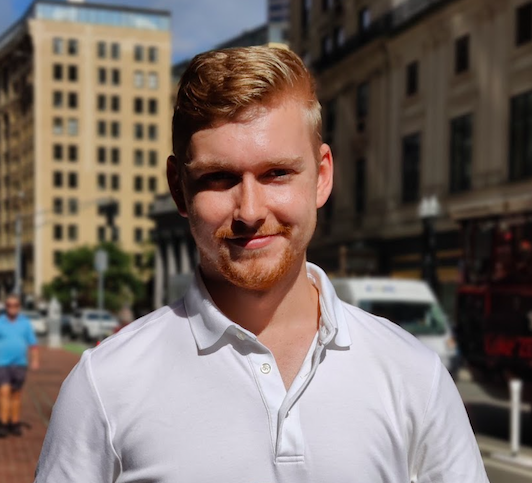
NABNASSET — Westford Select Board member Tom Clay is the subject of the latest Quarterly Veteran profile, an initiative started by the town’s Veterans Services Officer Colin Bode to highlight veterans by sharing their stories of military service with the community.
Clay served in the U.S. Army from 1991 to 1995, including assignments in South Korea and at Fort Bragg, where he served with a long-range surveillance unit. In the following Q&A below, Clay discusses his military career, a serious parachuting accident that led to his departure from the Army, the leadership lessons he carried into his post-Army career and his connections with other veterans. Bode also joins the conversation to discuss the bonds shared by veterans and the importance of highlighting their stories.

WestfordCAT: Tom, you served in the U.S. Army from 1991 to 1995. Can you talk about your experience in the service, your position and your responsibilities?
Clay: I applied for an ROTC (Reserve Officers’ Training Corps) scholarship before I applied to college. At that time, it was a separate application process, so my first commitment was actually to service and my second was to college.
I was somewhat active in ROTC, but the real transition for me was when I went to airborne school between my sophomore and junior years. That really opened my eyes to the kind of life that more elite troops led. When I went back to college and had to select my branch of service, I ended up selecting infantry.
When I graduated, I went to Infantry Officer Basic Course, Ranger School and antitank school. My first assignment was in South Korea.
I was assigned to the 2nd Infantry Division, 1st Battalion, 503rd Infantry, which was an air assault unit. For those listening or reading, that means we were helicopter-deployed. Wherever we went, we had to be able to carry everything by helicopter.
At the time, we had a six-day duty week, so we only had Sundays off and were in the field three weeks a month. It was an accelerated training environment.
Most of our training took place at a place called Warrior Base, which was up near the DMZ (Demilitarized Zone). We did exercises throughout the Korean Peninsula and a lot of joint-force exercises with our Korean Army counterparts. I had a lot of experiences there.
I was able to get my first platoon command and then became an executive officer, which is essentially the No. 2 position in a company. I had a lot of experiences by the time I finished my tour. I was there for a year.
By the time I was ready to leave, I’d really gotten the bug. I had orders to go to Fort Dix in New Jersey to be part of a basic training command, but I really wanted to spend more time with troops doing cutting-edge work in the infantry.
At the time, the Army had a proprietary phone system that connected different Army bases. I got the phone number of the assignment officer in Washington, D.C. and I probably called him 20 times. I really wanted to go to Fort Bragg.
Fort Bragg was home to the 18th Airborne Corps, which included the 82nd Airborne Division and one of the Ranger regiments. It was where a lot of the rapid-deployment forces were located. My wife was also in medical school at Duke University at the time, so I had two reasons I wanted to get to Fort Bragg.
One day, the assignment officer told me there was a new unit forming — a corps-level long-range surveillance company. They were building it from scratch.
To be eligible to be a lieutenant in the unit, you had to have already had a command, already been an executive officer and be Ranger-qualified. Luckily for me, I had all of those qualifications.
The next step was to call the commander. He was a very intimidating guy who had started his career as a Marine. He had later been head of the 82nd Airborne’s long-range surveillance unit and was being brought up by Gen. Gordon R. Sullivan to help establish this new unit.
I had a phone call with him and was explaining that I’d done everything I needed to do. He just cut me off and said, “Why don’t you just come down here? And if I don’t like you, I’ll fire you.”
That was the job interview.
It was a little bit like the movie “The Princess Bride,” where someone gets captured and is told, essentially, “Great job today. I might kill you tomorrow.” That’s a little bit what it was like for me in this unit.
We ended up recruiting a lot of great soldiers. We built six teams, each with six airborne Rangers. Two teams were basically scuba-deployed. They went to scuba school and could be deployed through submarine torpedo tubes.
Two teams were generalists who would typically be deployed by helicopter but were also airborne-qualified. The other two teams were HALO-qualified, which means high-altitude, low-opening parachuting.
We had a rapid-deployment mission. With 18 hours’ notice, we had to be on a plane going wherever they sent us. Fortunately, I was only in during peacetime.
They did a lot of simulation to make sure we were ready to go within 18 hours. We were frequently called up on alert, got on an airplane and didn’t know whether it was a live mission until they gave us our ammunition. As a soldier, you could look at the magazines and tell whether they contained blanks or live rounds.
You might be up in the air for 12 hours before you knew whether it was live or not. I had a great experience there, learned a lot and got to travel all around the world.
The end of my military career came after a routine jump. In airborne school, you jump from high up in the air, giving you plenty of time under the parachute to get your bearings and stay spread out.
If you’re training for a combat jump, it’s different. You’re jumping from about 400 feet, which is low, so you have a very short amount of time in the air. Once you get over the drop zone, you’re pushed out as quickly as possible.
Almost all the time, you’re going pretty fast and get spread out in the air. Every once in a while, though, you’ll hit another jumper who came out of the other door at the same time.
That’s what happened to me. Our parachutes became tangled and we ended up falling about 40 feet. I broke my back and was in a body cast for six months.
I got better though and jumped again. The next thing for me would have been to go to HALO school, but the surgeon wouldn’t let me. That also meant I couldn’t go to Special Forces selection or pursue some of the other things I might have done next.
That was when I separated from the service, and the journey that ultimately led me to Westford started.
My wife was finishing medical school and was going to have to match for residency. We had to pick a city and I had to go somewhere a year ahead of her while she still had a year to complete.
Without knowing where she was going to match, I had to relocate for whatever I was going to do next. We decided we would only look in Boston and Chicago.
I applied to business school, got into a school in Boston and that’s what brought us here initially.
When my wife finished her residency, her first medical practice was on Route 40 (Groton Road) in Westford. When our second baby came, she said only one of us was going to have a commute anymore. That meant we were going to move as close to her practice as possible.
We’ve loved it. We’ve been here for 24 years.
WestfordCAT: You mentioned being stationed in Korea near the DMZ, which is the demilitarized zone between North and South Korea. That’s obviously a potentially dangerous area where you had to remain vigilant. You also talked about your time at Fort Bragg and having to make decisions quickly in high-stress situations. How were you able to manage all of that?
Clay: One thing they train you as a combat officer is that you often need to make a quick decision. If it’s not the best decision, you can change your mind and do something else.
A lot of the training is designed to put you in impossible situations where there is no good choice, but you’ve got to pick one. Then you try to get your troops safely through whatever comes next.
A lot of the training at Ranger School is that kind of impossible-situation training. In Korea, there were also times when we had to make quick decisions.
I remember a mission during one of the big joint exercises called Team Spirit. It was a major joint-force exercise with the Korean Army and U.S. units.
We were helicopter-deployed, but the weather was so bad that they wouldn’t let us fly. Because I was commanding the antitank unit at the time, I had all the vehicles and could move people around.
We had to look at the map almost in a split second. I thought I saw a ferry crossing that would work and five minutes later we had to be on the move.
It was a lot of training and a lot of opportunities to be in those kinds of situations where you had to make a quick call.
At Fort Bragg, our mission was reconnaissance. We operated 50 to 150 miles behind enemy lines.
This was before drones were really a factor. There were satellites, but not the kind of satellite reconnaissance people use today. We put soldiers out there to watch train depots and crossing points, count vehicles and see what the enemy was doing. That was our job.
It was an intensive planning job. You’d have to study and triple-check the objective, make sure the team was prepared and make sure they had different routes for evacuation if they needed them.
But then you get out there and never know what’s going to happen. If a team made contact with the enemy, you’d have to get them out safely.
Again, these were all training exercises for us. Nonetheless, there were a lot of times when things didn’t go as planned and we had to absorb information and make the best call we could.
WestfordCAT: Being in a leadership role, what lessons did you take from that experience and apply later in life, including when you served on the Select Board and as chair?
Clay: One of the lessons came from the commander of the unit I joined at Fort Bragg. He was a very tough guy. His lieutenants were all from places like Princeton, where I went to school and Georgetown, so we were all in awe of him.
One thing I learned from him was that whenever a new piece of equipment showed up, an officer wasn’t necessarily the expert on the radio or a new machine gun.
He would sit down with the primary operator and have that person teach him. He gave them a real moment in the sun to show their expertise and be proud of what they did. He would learn a lot and ultimately know a great deal about everything, even if he didn’t know as much detail as the soldiers operating the equipment.
That’s something I think about all the time in my work, which is in technology commercialization. Whenever I’m in a new situation with people where I don’t yet have a relationship of trust, I try to find something that’s their area of expertise — something they’re proud of sharing — and ask them to teach me.
I think that’s something I observed that is really useful. I think it’s the same when you’re interacting with town staff.
Westford has a lot of extremely skilled people who are excellent at their jobs. A lot of people in the public don’t ever see that because they turn on the tap and the water comes out. If, God forbid, they have some kind of problem where they need law enforcement, officers show up and are respectful, careful and thorough.
I get the chance to see lots of people throughout town government and celebrate with them what they’re good at. That’s one of the lessons I took forward.
I also think there’s a sense of service. For people who’ve been in the service, that’s often a big motivation — to feel like you’re part of something bigger than yourself and that we’re all here as a team to advance the civic good and welfare of everybody.
That’s something I see every day in Westford, too. Typically, people aren’t going to work for the money in town government. Elected positions are volunteer positions and much of the work of the public is volunteer work.
People are doing it because they care and they may not always agree. Sometimes things get difficult when you have to make tough choices. But I’m always impressed by the sincerity of people and how they’re really coming at it from a sense of service. They want to be part of something bigger than themselves.
WestfordCAT: What were some of the most difficult parts of being in the Army and what were some of your favorite experiences that you look back on fondly?
Clay: I tell people who are considering joining the military that the U.S. Army, in particular, is like the biggest company in the world. There are amazing jobs and fantastic places to be and there are probably some places that aren’t as challenging or great.
I feel like I was really fortunate to always be in interesting and challenging environments where I could learn a lot from the people I was with.
There are experiences I had in the military that I think about today. We’d be doing live-fire exercises on a range with Apache helicopters providing support. We’d do a helocast, which means you’d fly in a helicopter, jump into a body of water and swim to shore.
Those kinds of experiences are in my head. They’re special things you can really only do in the military and they form some amazing memories.
But some of the tough things — I think what we ask our soldiers to do is pretty difficult from a family point of view.
When I was in South Korea, it was an unaccompanied tour. One thing the officers did was serve on what was essentially shore patrol, which meant going outside the base where troops would go to local bars and clubs.
Usually, that was where you’d see a lot of the pain and how difficult it was to be away. A lot of soldiers are really young and their partners might be in a situation on their own in a place where they don’t know anybody. Sometimes relationships suffered.
I think we ask a lot of people in the service and those would be some of the tougher times.
Sometimes in Korea, you’d also encounter soldiers who made serious mistakes. The military doesn’t have infinite tolerance for showing up drunk to formation, getting into a fight or losing your weapon.
There were some tough times when I had to watch a soldier who probably had potential and could have made it, but had fallen into a bad situation, made a bad choice and wasn’t able to stay on the team.
Those are probably some of the tougher things I remember.
WestfordCAT: Do you think your time in the service has made it easier to interact with veterans in town, as well as people who have family members currently serving? Colin, you could answer this as well, since you also served.
Clay: I’m lucky because I get to see Colin. He comes and presents to the Select Board from time to time and talks about the work he’s doing. I know he has a special relationship with lots and lots of our veterans.
We still have a few Korean War veterans here, I think, and it’s a really amazing group.
For me, I think there’s an immediate connection when you meet someone who has served. I can meet someone at Flag Day, for example, where we get to spend time with veterans.
I can meet someone who served in a different place, at a different time and in a different context — and almost right away have a language that we can use to talk about what they went through and what it meant to them.
If you’ve been in the service, you have an immediate connection. I’ve also served with veterans in town government.
I served with Erica Cole, who’s an Air Force veteran, on the School Committee and John Cunningham, who’s also an Air Force veteran. Even in town government, you sort of get each other. You know how your peers’ operating systems work and how they’re going to think through a decision.
It’s a huge advantage, and it’s a privilege to meet people who’ve also been in service.
Bode: I absolutely agree, Tom. I think it’s an instant connection.
One thing about being Westford’s Veterans Services Officer is that I’m privileged to go out and meet all of these veterans. I love hearing all the different stories about when they were in.
It’s funny how we can relate on so many different levels. Tom, you were talking about air assault operations and going into the water and I found myself thinking about an air assault raid we did at Fort Drum with the 777 howitzers.
It’s connections like that where you think, “Oh, my gosh, I remember doing something so similar.”
Even talking with a World War II veteran, he was talking about the “hurry up and wait” of the U.S. military, which is infamous. We have 80 years separating our service, but we can instantly relate on one aspect of the military.
Beyond that, there’s the sense of brotherhood and sisterhood that comes with military service. I did some time in law enforcement and some people try to say it’s similar, but nothing compares to the camaraderie of military service. It’s not like anything else on the face of the planet.
I love getting to continue that in Westford. I always say “it’s like Pokémon — I’ve got to catch them all.” I want to meet every veteran in Westford and hear all these great stories.
That’s another reason I set up this quarterly veteran event. It’s a great opportunity to highlight that these are real people who live in Westford, have served our country and have these great stories of their service.
I love being able to take a little piece of that and share it with the public.
It’s so great that we have such a great group of veterans in town. It’s very unique.
We recently brought Arthur, our Korean War veteran, to the American Heritage Museum. He ran into a truck he recognized from when he was in Korea as a radio operator in the U.S. Army.
It was so awesome to see him say he wanted to get a picture next to it and ask, “Can you send that to my daughter?”
Those are such special moments where he’s getting to remember moments from his service and I got to play a little role in that. It”s just awesome.
Clay: One thing that made me think of Colin, is something else I really value about my time in the service — I feel like I really got to meet America.
I got to meet men and women from all over the place. The bonds that kept us together overcame things that, in other circumstances, might have kept us apart.
I served with people who had very different ideas about gender roles. I was in the infantry, which was all male at that time. Some of the troops had different ideas than I did about gender roles, religion and politics.
Today, I almost feel like there are so many things trying to keep us apart, trying to keep us in our own lane and preventing us from communicating with people.
In the military, you could trust someone with your life and have them be a true friend. I would call many of these people today if I got into trouble, and they would come help. I would do the same for them.
They had totally different worldviews. On politics, for example, they could have completely opposite views from mine.
But somehow in the military, what kept us together was so much stronger than the things that were forcing us apart.
I don’t know that there are many other ways to have that experience today. For any young people thinking about joining the military, I grew up in a suburb that was very much like Westford and went to college with people very much like the people at Westford Academy.
The chance to actually see how the world really was and understand those differences — I would never have had that if I hadn’t been in the service.
Bode: I think about my artillery battery. When we went to Iraq, we had a young man who was an immigrant from Nepal and another who was an immigrant from Cape Verde.
There were people whose families were from Africa, Germany, Ireland and Mexico. It was a true melting pot, with all these different groups coming together and bonding through training and the idea of doing something greater than yourself and serving your country.
It’s such a selfless act, too. The bonds that form from that, especially from being in a combat zone in Iraq, are strong.
I’m getting married in Brazil next year and four people who served with me in Iraq are coming to the wedding. We went to war together and still stay in touch every day.
I also have people from basic training who I still have on Facebook and catch up with.
I always love the John F. Kennedy phrase, “Ask not what your country can do for you, but what you can do for your country.”
I always thought that really symbolizes military service. Kennedy served in the military himself, so I think about that quote often.
Clay: You reminded me of something else. Not only is the military a melting pot, but many of the troops I served with, at least in Korea, were relatively recent immigrants. Some of them were not yet U.S. citizens.
Every so often, there would be a citizenship swearing-in ceremony for soldiers who were currently in uniform. That was an amazing experience. They were so thrilled, and we were so thrilled for them.
People may not know that immigrants play an incredibly important role everywhere, but also in the military.
Bode: It’s huge, and they bring so much to the table.
For example, a lot of the interpreters we have in Germany are American citizens who speak two languages and whose families came from Germany.
In Iraq, many of the interpreters who speak Arabic are American citizens whose families came from Jordan, Syria or even Iraq itself.
There’s also the idea of having different perspectives and opinions. If everybody grew up the same way, I wouldn’t want to be in a combat situation or a serious situation where everybody was thinking exactly the same way I was.
I want different perspectives. I want people to have outside-the-box ideas. That doesn’t come from having only one group. It comes from having a big tent and a big team.
That’s what the Army is. It’s the biggest team in the world.
Our commander often called deployments the Super Bowl. You train and train and train, and then you go. This is the big match where we’re all going to be together as a team and work together to achieve our common objective.
It didn’t matter where you came from. It didn’t matter if you were rich or poor. We were all in it together.
WestfordCAT: I think that’s a really interesting perspective. It’s nice to know that people across generations who served during different periods can relate to one another because of their shared military experience. Thank you very much for joining us today, Tom and for sharing your story. Thank you Colin for putting this together. I think this is a really important initiative.
Clay: Agreed. Thank you to both of you. It’s been a lot of fun.
Bode: Thank you for your service, Tom.
Clay: You too. Thank you for your service.